
 The LUX Internet Shitty Comic Book Theater is embarrassed to present for your utter indifference...
THE FREAKISH AND HELLISHLY REPUGNANT SPRING-HEEL JACK!
SOMEONE OUGHTTA WRITE A SONG ABOUT HIM.
MAYBE THAT SOMEONE WILL BE...
YOU!!!

MAYBE NOT...

Probably nobody will...

Well, shit.

Don't forget to click on the pics to make them big enough to read. Don't wait to do it until you need glasses.
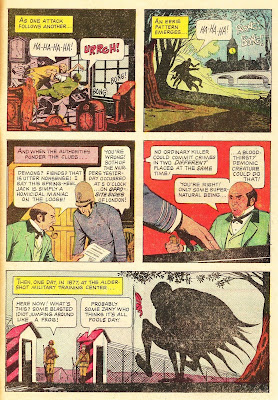

 The above story is absolutely true, except for the fact that none of it really happened. Here's what really did:
WIKIPEDIASpring Heeled Jack (also Springheel Jack, Spring-heel Jack, etc), is a character from English folklore said to have existed during the Victorian era and able to jump extraordinarily high. The first claimed sighting of Spring Heeled Jack that is known occurred in 1837.[1] Later alleged sightings were reported all over England, from London up to Sheffield and Liverpool, but they were especially prevalent in suburban London and later in the Midlands and Scotland.[2]
Many theories have been proposed to ascertain the nature and identity of Spring Heeled Jack. The urban legend of Spring Heeled Jack gained immense popularity in its time due to the tales of his bizarre appearance and ability to make extraordinary leaps, to the point where he became the topic of several works of fiction. Spring Heeled Jack was described by people claiming to have seen him as having a terrifying and frightful appearance, with diabolical physiognomy that included clawed hands and eyes that "resembled red balls of fire". One report claimed that, beneath a black cloak, he wore a helmet and a tight-fitting white garment like an "oilskin". Many stories also mention a "Devil-like" aspect. Spring Heeled Jack was said to be tall and thin, with the appearance of a gentleman, and capable of making great leaps. Several reports mention that he could breathe out blue and white flames and that he wore sharp metallic claws at his fingertips. At least two people claimed that he was able to speak comprehensible English.
The first accounts of Spring Heeled Jack were made in London in 1837 and the last reported sighting is said in most of the secondary literature to have been made in Liverpool in 1904.
The first report of Jack was from a businessman returning home late one night from work, who told of being suddenly shocked as a mysterious figure jumped with ease over the high railings of a cemetery, landing right in his path. No attack was reported, but the submitted description was disturbing: a muscular man with devilish features including large and pointed ears and nose, and protruding, glowing eyes.
Later, in October 1837, a girl by the name of Mary Stevens was walking to Lavender Hill, where she was working as a servant, after visiting her parents in Battersea. On her way through Clapham Common, according to her later statements, a strange figure leapt at her from a dark alley. After immobilizing her with a tight grip of his arms, he began to kiss her face, while ripping her clothes and touching her flesh with his claws, which were, according to her deposition, "cold and clammy as those of a corpse". In panic, the girl screamed, making the attacker quickly flee from the scene. The commotion brought several residents who immediately launched a search for the aggressor, who could not be found.
The next day, the leaping character is said to have chosen a very different victim near Mary Stevens' home, inaugurating a method that would reappear in later reports: he jumped in the way of a passing carriage, causing the coachman to lose control, crash, and severely injure himself. Several witnesses claimed that he escaped by jumping over a nine foot-high (2.7 m) wall while babbling with a high-pitched and ringing laughter.
A few months after these first sightings, on January 9, 1838, the Lord Mayor of London, Sir John Cowan, revealed at a public session held in the Mansion House an anonymous complaint that he had received several days earlier, which he had withheld in the hope of obtaining further information. The correspondent, who signed the letter "a resident of Peckham", wrote:
It appears that some individuals (of, as the writer believes, the highest ranks of life) have laid a wager with a mischievous and foolhardy companion, that he durst not take upon himself the task of visiting many of the villages near London in three different disguises — a ghost, a bear, and a devil; and moreover, that he will not enter a gentleman's gardens for the purpose of alarming the inmates of the house. The wager has, however, been accepted, and the unmanly villain has succeeded in depriving seven ladies of their senses, two of whom are not likely to recover, but to become burdens to their families.
At one house the man rang the bell, and on the servant coming to open door, this worse than brute stood in no less dreadful figure than a spectre clad most perfectly. The consequence was that the poor girl immediately swooned, and has never from that moment been in her senses. The affair has now been going on for some time, and, strange to say, the papers are still silent on the subject. The writer has reason to believe that they have the whole history at their finger-ends but, through interested motives, are induced to remain silent.
Though the Lord Mayor seemed fairly sceptical, a member of the audience confirmed, "servant girls about Kensington, Hammersmith and Ealing, tell dreadful stories of this ghost or devil". The matter was reported in The Times on 9 January, and other national papers on 10 January, and the day after that (January 11) the Lord Mayor showed a crowded gathering a pile of letters from various places in and around London complaining of similar "wicked pranks". The quantity of letters that poured into the Mansion House suggests that the stories were widespread in suburban London. One writer said several young women in Hammersmith had been frightened into "dangerous fits", and some "severely wounded by a sort of claws the miscreant wore on his hands". Another correspondent claimed that in Stockwell, Brixton, Camberwell and Vauxhall several people had died of fright, and others had had fits; meanwhile, another reported that the trickster had been repeatedly seen in Lewisham and Blackheath. The Lord Mayor himself was in two minds about the affair: he thought "the greatest exaggerations" had been made, and that it was quite impossible "that the ghost performs the feats of a devil upon earth", but on the other hand someone he trusted had told him of a servant girl at Forest Hill who had been scared into fits by a figure in a bear's skin; he was confident the person or persons involved in this "pantomime display" would be caught and punished. The police were instructed to search for the individual responsible, and rewards were offered. A peculiar report from The Brighton Gazette, which appeared in the April 14, 1838 edition of The Times related how a gardener in Rosehill, Sussex, had been terrified by a creature of unknown nature. The Times wrote that "Spring-heeled Jack has, it seems, found his way to the Sussex coast", even though the report bore little resemblance to other accounts of Jack. The incident occurred on April 13, when it appeared to a gardener "in the shape of a bear or some other four-footed animal". Having attracted the gardener's attention by a growl, it then climbed the garden wall and ran along it on all fours, before jumping down and chasing the gardener for some time. After terrifying the gardener, the apparition scaled the wall and made its exit.
Perhaps the best known of the alleged incidents involving Spring Heeled Jack were the attacks on two teenage girls, Lucy Scales and Jane Alsop. The Alsop report was widely covered by the newspapers, including a piece in The Times, while a single paper covered the Scales report, presumably because Alsop came from a comfortably well-off family and Scales from a family of tradesmen. This coverage by newspapers fuelled the collective hysteria surrounding the case.
Alsop case
Jane Alsop reported that on the night of February 19 she answered the door of her father's house to a man claiming to be a police officer, who told her to bring a light, claiming "we have caught Spring-heeled Jack here in the lane". She brought the person a candle, and noticed that he wore a large cloak. The moment she had handed him the candle, however, he threw off the cloak and "presented a most hideous and frightful appearance", vomiting blue and white flame from his mouth while his eyes resembled "red balls of fire". Miss Alsop reported that he wore a large helmet and that his clothing, which appeared to be very tight-fitting, resembled white oilskin. Without saying a word he caught hold of her and began tearing her gown with his claws which she was certain were "of some metallic substance". She screamed for help, and managed to get away from him and ran towards the house. He caught her on the steps and tore her neck and arms with his claws. She was rescued by one of her sisters, after which her assailant fled. Scales case
Eight days after the attack on Miss Alsop, on February 28, 1838[11], 18-year-old Lucy Scales and her sister were returning home after visiting their brother, a butcher who lived in a respectable part of Limehouse. Miss Scales stated in her deposition to the police that as she and her sister were passing along Green Dragon Alley, they observed a person standing in an angle of the passage. She was walking in front of her sister at the time, and just as she came up to the person, who was wearing a large cloak, he spurted "a quantity of blue flame" in her face, which deprived her of her sight, and so alarmed her, that she instantly dropped to the ground, and was seized with violent fits which continued for several hours.
Her brother added that on the evening in question, he had heard the loud screams of one of his sisters moments after they had left his house and on running up Green Dragon Alley he found his sister Lucy on the ground in a fit, with her sister attempting to hold and support her. She was taken home, and he then learned from his other sister what had happened. She described Lucy's assailant as being of tall, thin, and gentlemanly appearance, covered in a large cloak, and carrying a small lamp or bull's eye lantern similar to those used by the police. The individual did not speak nor did he try to lay hands on them, but instead walked quickly away. Every effort was made by the police to discover the author of these and similar outrages, and several persons were questioned, but were set free.
The legend spreads
The Times reported the alleged attack on Jane Alsop on March 2, 1838 under the heading "The Late Outrage At Old Ford".[9] This was followed with an account of the trial of one Thomas Millbank, who, immediately after the reported attack on Jane Alsop, had boasted in the Morgan's Arms that he was Spring Heeled Jack. He was arrested and tried at Lambeth Street court. The arresting officer was James Lea, who had earlier arrested William Corder, the Red Barn Murderer. Millbank had been wearing white overalls and a greatcoat, which he dropped outside the house, and the candle he dropped was also found. He escaped conviction only because Jane Alsop insisted her attacker had breathed fire, and Millbank admitted he could do no such thing. Most of the other accounts were written long after the date; contemporary newspapers do not mention them.
After these incidents, Spring Heeled Jack became one of the most popular characters of the period. His alleged exploits were reported in the newspapers and became the subject of several Penny Dreadfuls and plays performed in the cheap theatres that abounded at the time. The devil was even renamed "Spring Heeled Jack" in some Punch and Judy shows, as recounted by Henry Mayhew in his London Labour and the London Poor:
"This here is Satan,-we might say the devil, but that ain't right, and gennelfolks don't like such words. He is now commonly called 'Spring-heeled Jack;' or the 'Rossian Bear,' - that's since the war."
—Henry Mayhew, London Labour and the London Poor, p. 52
But, even as his fame was growing, reports of Spring Heeled Jack's appearances became less frequent if more widespread. In 1843, however, a wave of sightings swept the country again. A report from Northamptonshire described him as "the very image of the Devil himself, with horns and eyes of flame", and in East Anglia reports of attacks on drivers of mail coaches became common. He was linked with the so-called "Devil's Footprints" that appeared in Devon in February 1855.In the beginning of the 1870s, Spring Heeled Jack was reported again in several places distant from each other. In November 1872, the News of the World reported that Peckham was "in a state of commotion owing to what is known as the "Peckham Ghost", a mysterious figure, quite alarming in appearance". The editorial pointed out that it was none other than "Spring Heeled Jack, who terrified a past generation". [14] Similar stories were published in The Illustrated Police News. In April and May 1873, there were numerous sightings of the "Park Ghost" in Sheffield, which locals also came to identify as Spring Heeled Jack.This news was followed by more reported sightings, until in August 1877 one of the most notable reports about Spring Heeled Jack came from a group of soldiers in Aldershot's barracks. This story went as follows: a sentry on duty at the North Camp peered into the darkness, his attention attracted by a peculiar figure bounding across the road towards him, making a metallic noise. The soldier issued a challenge, which went unheeded, and the figure vanished from sight for a few moments. As the soldier turned back to his post, the figure reappeared beside him and delivered several slaps to his face with "a hand as cold as that of a corpse". Attracted by the ensuing noise, several men rushed to the place, but they claimed that the character leapt several feet over their heads and landed behind them. One of the guards shot at him, with no visible effect other than to enrage his target; some sources claim that the soldier may have fired blanks at him, merely used to make warning shots. The strange figure then disappeared into the surrounding darkness.[15] Lord Ernest Hamilton's 1922 memoir Forty Years On mentions the Aldershot appearances of Spring Heeled Jack; however, he (apparently erroneously) says that they occurred in the winter of 1879 after his regiment, the 60th Rifles, had moved to Aldershot, and that similar appearances had occurred when the regiment was barracked at Colchester in the winter of 1878. He adds that the panic became so great at Aldershot that sentries were issued ammunition and ordered to shoot "the night terror" on sight, following which the appearances ceased. Hamilton thought that the appearances were actually pranks, carried out by one of his men, a Lieutenant Alfrey.[16] Lincolnshire
In the autumn of 1877, Spring Heeled Jack was reportedly seen at Newport Arch, in Lincolnshire, wearing a sheep skin. An angry mob supposedly chased him and cornered him, and just as in Aldershot a while before, residents fired at him to no effect. As usual, he was said to have made use of his leaping abilities to lose the crowd and disappear once again.
Liverpool
By the end of the 19th century, the reported sightings of Spring Heeled Jack were moving towards western England. Around 1888, in Everton, in north Liverpool, Spring Heeled Jack allegedly appeared on the rooftop of Saint Francis Xavier's Church, in Salisbury Street. In 1904 there were reports of appearances in nearby William Henry Street. 20th century
A similar figure known as Pérák, the Spring Man of Prague was seen in Czechoslovakia around 1939-45. This character, like Jack, went on to become a folklore hero, even starring in several animated superhero cartoons, fighting the SS. On June 18, 1953, a figure in part resembling some descriptions of Spring Heeled Jack was sighted in a pecan tree in the yard of an apartment building in Houston, Texas. Mrs. Hilda Walker, Judy Meyers, and Howard Phillips described a man in a "black cape, skin-tight pants, and quarter-length boots", and "grey or black tight-fitting clothes". In South Herefordshire, not far from the Welsh border, a travelling salesman named Marshall claimed at some unspecified time until as late as 1997 to have had an encounter with a Spring Heeled Jack–like entity in 1986. The man leaped in enormous, inhuman bounds, passed Marshall on the road, and slapped his cheek. He wore what the salesman described as a black ski-suit, and Marshall noted that he had an elongated chin.[19] Finally, Jack also resembles in appearance and behavior (though Jack is more mischievous than malicious) the Japanese thunder god, Raiden. Stories gave Raiden a black appearance with red eyes and prodigious leaping abilities, but unlike Jack, Raiden was predatory, allegedly consuming men's navels. Theories No one was ever caught and identified as Spring Heeled Jack; combined with the extraordinary abilities attributed to him and the very long period during which he was reportedly at large, this has led to all sorts of theories of his nature and identity. While several researchers seek a rational explanation for the events, other authors explore the more fantastic details of the story to propose different kinds of paranormal speculation.Sceptical investigators have dismissed the stories of Spring Heeled Jack as mass hysteria which developed around various stories of a bogeyman or devil which have been around for centuries, or from exaggerated urban myths about a man who clambered over rooftops claiming that the Devil was chasing him.
Other researchers believe that some individual(s) may have been behind its origins, being followed by imitators later on.Spring Heeled Jack was widely considered not to be a supernatural creature but rather one or more persons with a macabre sense of humour.This idea matches the contents of the letter to the Lord Mayor, which accused a group of young aristocrats as the culprits, after an irresponsible wager. A popular rumour circulating as early as 1840 pointed to an Irish nobleman, the Marquess of Waterford, as the main suspect. Haining suggested this may have been due to him having previously had bad experiences with women and police officers. The Marquess was frequently in the news in the late 1830s for drunken brawling, brutal jokes and vandalism, and was said to do anything for a bet; his irregular behaviour and his contempt for women earned him the moniker "the Mad Marquis", and it is also known that he was in the London area by the time the first incidents took place. But The Waterford Chronicle was able to report his presence at the St Valentine's Day Ball at Waterford Castle, giving him an alibi for the reported attacks on Jane Alsop and Lucy Scales that are central to Jack's alleged existence. Nevertheless, in 1880 he was named as the perpetrator by the Rev. E. C. Brewer, who attested that the Marquess "used to amuse himself by springing on travellers unawares, to frighten them, and from time to time others have followed his silly example".[23] In 1842, the Marquess of Waterford married and settled in Curraghmore House, Ireland, and reportedly led an exemplary life until he died in a riding accident in 1859. Spring Heeled Jack remained active for decades after, which leads the aforementioned modern researchers[who?] to the same conclusion as Brewer's.
Sceptical investigators have asserted that the story of Spring Heeled Jack was exaggerated and altered through mass hysteria, a process in which many sociological issues may have contributed. These include unsupported rumours, superstition, oral tradition, sensationalist publications, and a folklore rich in tales of fairies and strange roguish creatures. Gossip of alleged leaping and fire-spitting powers, his alleged extraordinary features and his reputed skill in evading apprehension captured the mind of the superstitious public — increasingly so with the passing of time, which gave the impression that Spring Heeled Jack had suffered no effects from aging. As a result, a whole urban legend was built around the character, being reflected by contemporary publications, which in turn fueled this popular perception.
Paranormal conjectures
A variety of paranormal explanations have been proposed to explain the origin of Spring Heeled Jack, including that he was an extraterrestrial entity with a non-human appearance and features, (e.g., retro-reflective red eyes, or phosphorus breath) and a superhuman agility deriving from life on a high gravity world, jumping ability and strange behaviour[25] and that he was a demon, accidentally or purposefully summoned into this world by practitioners of the occult, or who made himself manifest simply to create spiritual turmoil. The vast urban legend built around Spring Heeled Jack influenced many aspects of Victorian life, especially in contemporary popular culture. For decades, especially in London, his name was equated with bogeymen, as a means of scaring children into behaving by telling them that if they were not good, Spring Heeled Jack would leap up and peer in at them through their bedroom windows, by night.
However, it was in fictional entertainment where the legend of Spring Heeled Jack exerted the most extensive influence, owing to his allegedly extraordinary nature. Almost from the moment the first incidents gained public knowledge, he turned into a successful fictional character, becoming the protagonist of many penny dreadfuls from 1840 to 1904. Several plays where he assumed the main role were staged as well.

 Greetings, terrestrial assholes! It's me, Eros, your great friend and admirer... NOT! I have been browsing my archives and found something I simply could not believe. Here is a story about a creature that is actually more stupid than a stupid human! Of course, this blockhead is a native of your backward, idiotic world, which certainly explains a lot. Wait 'til you see how easily this dunderheaded dipshit is defeated! What a laugh! What a maroon!


