
The following was sent to me by Bettie Blogger (Kevin) from Bettiepage.com and
bettiepageblog.blogspot.com
4.09.2009
Lux Redux
So, last night I was scouring the internet for a great interview with Lux I read years ago, in which he makes the very legitimate complaint that as punk rock is being canonized for history in books like PLEASE KILL ME and movies like Don Letts' PUNK: ATTITUDE, The Cramps aren't there -- despite the fact that they played CBGBs and Max's ALL THE TIME. I finally needed to use the "wayback machine" to dig it up. Since it's no longer on the net, I feel morally justified putting it up in its entirety. I also found an additional interview with Lux and an amazingly candid interview with Ivy about how hard it is to pull off "basic" riffs -- again, showing how much "smarter" and more "technically proficient" bands still manage to get it all wrong!
Since I don't want this just to be reprintsville, I'll add my own personal anecdote. To be a good musician, it seems you first must be a fan... which is why it was so oddly impressive when, at one of the Hootenannys a number of years ago, Lux, after turning in a breathtakingly unhinged performance that left his latex outfit in tatters, could clearly be seen in a Hawaiian shirt and black jeans, standing next to Ivy, grinning as he watched THE REVEREND HORTON HEAT with the enthusiam of a 15 year old kid. It was an unguarded glimpse "Erik Purkhiser - music fan" who was the brains and heart behind the stomping, crawling, flailing id of "Lux Interior" that just amped my already considerable appreciation for the band.
Okay, on to interviews by others:
Here's a great interview, seemingly lost in the sands of time:
THE CRAMPS - All The News From Badsville Lux Interior interviewed by DJ Johnson
It's a well known story by now. Lux Interior (not his real name) met Poison Ivy Rorschach (not her real name) in California as she was hitchhiking. Of course, there's an equally well known story where they met in a college class, but I like this one better because it holds that Ivy was wearing jeans with a big hole in the backside, through which Lux saw bright red panties and knew instantly that he'd found his true love. You've gotta admit, it's a better story. I didn't
ask Lux which one was correct when I interviewed him one late September afternoon, partly because I was afraid the boring college story would turn out to be true. Instead, we talked about records, cars, soul, blues, records, collecting stuff (like records), sexploitation flicks, sex in general, and the music on Big Beat From Badsville, the latest LP/CD from The Cramps. Most everyone knows at least something about The Cramps, so we'll dispense with the intro and jump right in.
* * *
Cosmik: You have new digs since your last album. How did you end up with Epitaph, a label known for high-speed punk?
Lux: Well, they put out our last album on vinyl because we were on Medicine Records, who is going through Warner Brothers, and they don't do vinyl because they think it's an ancient thing of the past. So Epitaph contacted them and said "you're not putting it out on vinyl, at least let US put it out on vinyl." So they let Epitaph put out Flame Job on vinyl. We met them at that time when that happened because they were bringing us test pressings, and we got to know them then and really dug them. They all seem like real people as opposed to some of the people we were dealing with at Warner Brothers. Then Medicine Records went out of business
and we just went straight to them.
Cosmik: What's your general opinion of that type of music, the stuff that'smost commonly associated with Epitaph?
Lux: I don't know, I'm not too familiar with it. I'm not too into what you'd think of when you say "punk rock." I mean, everybody's got a different idea of what punk rock is. I think of it as what was going on in the Bowery when we started playing, but the fast melodic punk
rock that's coming out now... I think it's great, I think it's a good thing, and it's doing its job for a lot of people, but I don't listen to it too much. Although they've got quite a lot of good stuff on that label, and they've got another label called Fat Possum that's got an amazing record by T. Model Ford, which I really love.
Cosmik: Yeah. I love the R.L. Burnside, too. That raw blues. Lux: Uh huh. I just like rock and roll, and that kind of punk rock stuff, it's more of a pop music. I could dig going to a club and being there, but I don't sit at home listening to it.
Cosmik: Do you think the label "punk" ought to be retired at this point because it doesn't really mean any one thing?
Lux: Yeah, cuz I don't really know what it is. Actually, I'd consider what Epitaph is doing to be punk rock. It's kinda like... we started that term "psychobilly" when we started in the spring of '76, we were advertising ourselves as that and saying that's what we did. To us, it was a mixture of garage punk from the 60s and rockabilly and all that, and all the things we do. Later on, it became... There is a thing called "psychobilly," which is real fast, 90 mile an hour rockabilly-flavored punk rock, and I don't think we're that. I think the same thing's happened to punk rock. It's become something different from what it was originally, and so what people think of as punk rock now is not the same thing as what I thought of as punk rock for years.
Cosmik: Ask any three people what punk rock is and you'll get three different answers. Lux: Oh yeah. I like William Burroughs' definition the best. He said "I always thought that a punk was somebody that took it up the ass." (Laughs)
Cosmik: {Laughs) Never heard that one, but it works. Have labels tried to change your sound in the past?
Lux: No. Nobody has, that I can think of, outside of a casual remark or something about this or that. They've never really attempted to say "I want you guys to do this or that..."
Cosmik: ...to make you more commercial.
Lux: Yeah, you know, there've been some really timid attempts, but I think we just appear too crazy to try and even get started in that direction.
Cosmik: So sometimes your scary personae will come in handy.
Lux: It has! A lot of times people will come to see us, people from record companies, and they're supposed to come back later, and they don't. They'll say "I was too freaked out! I saw your show and I left." So that's good. It keeps away the evil spirits.
Cosmik: The new album is just what we all expected: another batch of great Cramps tunes. I don't think there's another band that's been doing it as long as you that has stayed faithful to their original sound and vision. How have you been able to do that through all the personnel changes and with all the changes in the sounds around you?
Lux: Well, you know it's just basically that me and Ivy have always written
all the songs, and we had the idea for this band before we'd even HAD any bands, because we were going to see other people in bands. That really doesn't change. We still listen to a lot of the same old records that we listened to back then, so it seems perfectly natural to us. We
just like rock and roll. It's no effort to keep doing this. It would be an effort to do something else cuz this just seems like the bullseye of what's fun and what gets us out to an exciting show in a town near you.
Cosmik: Are you a soul music fan?
Lux: Oh yeah.
Cosmik: You know the old "answer records," like "Work With Me Annie," and
then Etta James answered with "Roll With Me, Henry," and then somebody
came up with "Annie Had A Baby..." I noticed you've continued the legend
of Sheena. "Sheena's In A Goth Gang Now" is punk, but there's some R&B
in your approach to some of your tunes.
Lux: It's strange; no one ever comments on it. Everybody says we do garage punk and psychedelic and rockabilly, but there's all kinds of 60s and 70s soul in our songs, too, and definitely rhythm and blues, and blues. "Can Your Pussy Do The Dog," you know, that was just like a 60s soul song. Most of our albums have that influence, but it seems like nobody ever brings that up. We love soul music.
Cosmik: Most bands make their influences obvious from song to song, but you seem to have distilled a lot of different influences into a very consistent single thing, so I wonder if maybe a lot of people can't actually hear the R&B or any of the other influences anymore, like they just hear "the Cramps' sound."
Lux: Yeah, I think a record collector, somebody who just can't get enough music and buys all kinds of music and listens to it, would hear it, but most people wouldn't. Led Zeppelin was a band that came straight from the blues. You listen to what they did in the 70s, and most people would think that was totally original and didn't come from ANYWHERE... but it did. And it's the same with most other bands.
Cosmik: I want to ask you about the imagery in some of your music. "Monkey With Your Tail," for instance, is another hot dose of animalism, which is one of the aspects of your music that fascinates me. What is it about that aspect of human nature that draws you?
Lux: You know, I can't really give you an honest answer, cuz I ain't got one. It seems like that comes up a lot in the records we listen to. A real rock and roll song, I think, is about sex most of the time. So that leads you to "I Wanna Be Your Dog." That's one of the things that a lot of people would like to pretend, that human beings are above being like animals. We kind of enjoy that idea, but that that's what we are: one more animal.
Cosmik: And the best sex is animalistic?
Lux: Yeah, well, sex is pretty animalistic, I think. It can have more than that, but that was definitely part of the blues, kind of an attack on that idea that now we're cultured, civilized people and we're above that kind of thing. Seems like the blues has always been about "no, we're not above that kind of thing."
Cosmik: The monkey sounds in that song are great. I have that song on a tape segued from "Wild Women Of Wongo" by The Tubes, by the way. Killer segue.
Lux: I've seen The Tubes several times now, but I saw them before they had any records out. They were opening for The New York Dolls right as The Dolls' first record came out in San Francisco. We were not expecting anything. It was just a band named The Tubes, you know? It could have been anything. It could have been four guys with beards come out and play violins, you know? And out came Fee Waybill with these two-foot high platforms. We weren't ready for it at all. They were amazing, and then The New York Dolls came out and they were amazing, too.
Cosmik: Man, I don't know if I could stand a double header like that. I'd
be too hyped.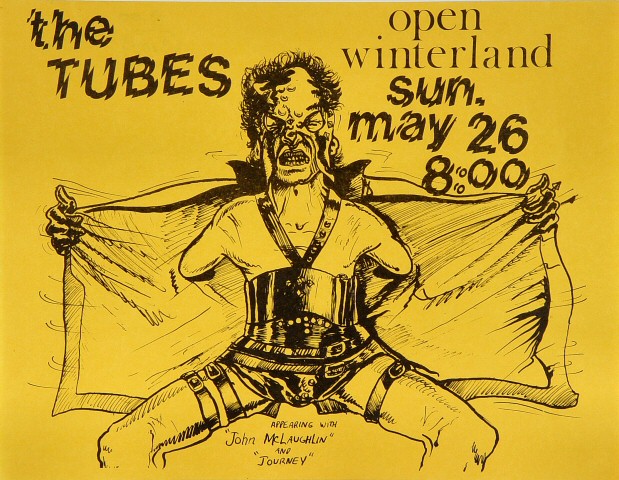
Lux: I remember that night David Johansen (NY Dolls singer) came out wearing
a T-shirt that had a picture of Marilyn Monroe on the front... It was like a black and white picture, and he had painted her hair blonde and her face pink, and then he put lipstick on her lips. Then when he started sweatin' about the fourth or fifth song, her lips just ran down his
stomach. (Laughs)
Cosmik: What a cool thing to see! The Tubes, and maybe sometimes The Dolls, had a certain level of camp in their performances. Do you think there's an element of that in your show?
Lux: I would say The Tubes were a more theatrical group. We don't do anything very theatrical except be ourselves. You wouldn't call The New York Dolls a theatrical kind of group. They were just an R&B band that came out and played as themselves, and that's kind of what we do. We don't have props, but it's definitely entertaining.
Cosmik: Most of your sex songs are about danger in one way or another. The image of woman as predator. Does sex without danger bore you?
Lux: Well, geez, I think just about any sex is exciting, but it's even more exciting if there's a little danger involved, I'm sure.
Cosmik: Your music... the sound of it... is dangerous, too. Put the imagery with the sound and you're probably the most dangerous sounding band of all time. What kind of resistance have you seen from churches or parent groups over the years?
Lux: Oh, some people are really upset by us and go to great lengths to try and do something about it, but it's never caused us too much of a problem. Except that we've missed out on opportunities because of it. We've had the cops come, like in Florida, cops come to watch and make sure we don't get out of hand. Florida's pretty back there, and always has been, for
some reason. I don't know why that is.
Cosmik: Aw, they're just still mad because Morrison died and got off the hook.
Lux: Yeah, they're lookin' for somebody.
Cosmik: Let me throw a quote at you, one you know well... "Each one of us, in his timidity, has a limit beyond which he is outraged." Of course, the quote goes on toward analyzing public attitude, but...what are YOUR limits? What are you outraged by?
Lux: What outrages me is that people can be so satisfied and half asleep. I don't want to go back to the 50s or something, but I do remember a time when cars looked like rocket ships, and people wanted to have a wild time and dress sexy and dance sexy and try new, crazy things. It seems like these days there's an abundance of boringness and timidity, and that's the kind of thing that outrages me, you know? Boring people, that's nothing new, but the numbers are growing rather than going down. It's not a good sign.
Cosmik: What is your life like? I mean when you're not recording or touring.
What do you like to do when there's no claims on your time?
Lux: We have a huge collection of old horror comics from the 50s... And I have 80-some old 3-D cameras; I do a lot of 3-D photography. That's a passion of mine. I watch Ivy prance around the house in fabulous sexy outfits...
Cosmik: Not a bad life!
Lux: No, it's great. I can't think of any way to improve upon it. We have a huge record collection of 78s and 45s, and we play that stuff all the time. We have a huge collection of sexploitation videotapes, like the stuff Something Weird is putting out. [Ed.Note: Something Weird is a
Seattle-based video company. Call 206-361-3759 or visit their website at http://www.somethingweird.com/.] We're involved in the custom car thing that's happening here in LA, and we go to a lot of that stuff. We have a '56 Dodge.
Cosmik: Wouldn't happen to have a flamejob on it, would it?
Lux: Actually, it doesn't. We want to get some other cars, but we don't have anywhere to park them right now. I don't have the heart to put a flamejob on this one because when we bought it, it only had 38,000 miles on it and it was like brand new. We got it for like $1,500. I'd rather
buy something that's a little bit more of a junker, because if it's junky you don't mind stripping the paint and customizing it and putting flames on it. But not this one.
Cosmik: It would feel like sacrilege?
Lux: Yeah. It's stock. Except that we put leopard-skin seat covers in. That's the only thing that's not stock. It's pretty amazing to have a completely stock car from 1956 that's so new. You don't wanna mess that up.
Cosmik: Do you turn your own wrenches?
Lux: Oh, it depends. I spent my life fixing cars, but lately I just don't have the time. When something goes wrong with it, unless it's something pretty easy to fix, I'd just as soon let someone else do it because I just don't have the time anymore.
Cosmik: Trying to picture you working on an engine...
Lux: Oh yeah, I've done that all my life.
Cosmik: So you were into the car club scene?
Lux: Yeah. Back when I first started buying cars, I'd always buy 'em, they wouldn't be running, and I'd have to put a new engine in 'em or something. I'm pretty much... I'm about a half-ass mechanic, I'd say. Course, I couldn't work on one of these cars today, but the old cars I can. You
open up the hood on these cars today and it looks like a computer.
Cosmik: It's not like anything you'd be proud to drive, anyway. I still dream of having a '57 T-Bird. Someday I'll have it.
Lux: When I was a kid, I used to say "someday I'll have one," and I hate to say I still haven't got one, but maybe that'll happen before they throw me in the box.
Cosmik: What, you mean a '57 Bird? You wanted one, too?
Lux: Yeah, or a '55 or '56.
Cosmik: Cool. Those were great cars. Let's shift gears a bit here and talk about your record collection, because I know that's one of your biggest passions. You've been at it a long time now.
Lux: Yeah, actually my brother was a real juvenile delinquent in the 50s, and he had an amazing collection of 45s. At one point he decided he didn't want them anymore and he gave me this huge collection of his stuff. That was in the early 70s, and music was really boring at that time. When I met Ivy, we were discovering all these rockabilly records in junk stores in Sacramento. Ever since then we've been record collectors, and we've amassed quite a bunch.
Cosmik: What kind of space does the collection require at this point?
Lux: Oh, a bunch of rooms. More room than we've got, because they're stacked up in boxes all over the place instead of being easily accessible, but we've got some great stuff. We've got all the Sun Records 45s and 78s, except for a few. There are like maybe 6 or 8 of the early blues numbers that we don't have.
Cosmik: Whoa, so you're saying you actually own almost everything ever put out by Sun?
Lux: Yeah, we have over 200. When me and Ivy first met, we had an old '61 Chevy station wagon, and we heard that you could still buy Sun Records in Memphis, so we drove to Memphis from Sacramento. This was in 1972. You could buy Sun Records at six for a dollar at Selective Hits, which was the Sun warehouse. So you could buy "Flying Saucers Rock And Roll" by Billy Lee Riley for 18 cents. We went in and bought boxloads of them, kept one of each, and used the rest to trade for other stuff. When we lived in Ohio it was especially amazing because we'd just find unbelievably rare things. All the southerners would come to Ohio to work in the Steel Mill and the rubber companies in the 50s and 60s, and they brought their records with them that never made it out of the south, and they ended up in the junk stores around Akron and Cleveland. We went in there and got that stuff. We got stuff like the Teen Kings record... it's
Roy Orbison's band, before he was on Sun, doing "Ooby Dooby." It's a different recording. There were only about 300 [pressed], and we found one of those. We found all these unbelievably obscure records. We've been doing that for 25 years or something, so we've amassed a lot of them.
Cosmik: Did you ever go through the business of cataloging all that?
Lux: We have them in alphabetical order, like we have all the rockabilly in one place, all the rock and roll instrumentals in one place, all the surf instrumentals in another place, R&B in another place, blues, you know...
Cosmik: With all of that, it seems like you'd be overwhelmed by choices. How do you even decide what to listen to?
Lux: Well, over the years you get to know them just like they're friends. Like friends you have on your mind, and you think "oh, I wanna listen to that," and you just go grab it. When you've got a LOT of records, it's more fun, because you can just go looking through them, and you
always find something that you don't remember what it sounds like, and you rediscover something you haven't heard in ten years.
Cosmik: So if you're in the mood for Little Walter, you might find yourself listening to Charlie Musselwhite?
Lux: Uh huh. I think we've got a pretty good selection. When we first started out, it was collecting the vocal groups from the 50s, like The Orioles and the Castelles, and all these weird R&B vocal groups that would do the real slow stuff, you know, the stuff that's even slower
than doo-wop. The slow, dreamy, druggy kind of stuff. As we were doing that, we just ran into rockabilly by accident. We'd buy some record, put the needle down, and we'd say "I wonder what THIS sounds like?" And it would be some guy going "HYAYAYAYAYAHH!!!" And we'd go "My GOD," you know? And that's when it first dawned on us, I think, because we were thinking we wanted to have a band. We'd go see all these bands and we'd be thinkin' to ourselves "boy, it would be cool if WE had a band," and then it dawned on us because of some record we brought home, "geez, we could play this stuff." There were all these bands, like The Rolling Stones and The New York Dolls, that took R&B and did something with it, but nobody had really done anything with rockabilly yet. We thought that would give us a real head start, that we'd have some resources to do something that came from the blues but hadn't been done yet.
Cosmik: Hey, when you drove away from Selective Hits with all those Sun records, did you feel like you'd just robbed Fort Knox?
Lux: Oh, yeah! Oh, man... And they not only had Sun records, but they had stuff from a lot of other labels that were there, too. It was just amazing. Then when we went to Ohio... We basically went there to get jobs to buy guitars, because we were on our way to New York, to CBGB's and everything, because we knew we wanted to have a band. When we got to Ohio we found there was a place THERE selling Sun records really cheap, too. They had done the same thing. They had bought a bunch of records earlier at Selective Hits in Memphis, and they were selling them for a dollar to five dollars, and the really rare ones were ten dollars.
Cosmik: Which is still one hell of a buy.
Lux: Yeah, oh... I can't even imagine what the really rare records are going for these days. But that's what's great. These days, you don't have to have it that way. You can buy reissues. Back then, there was only one way to get that stuff. You had to find it somewhere, in a junk store or
something, you just had to discover it. Which was the more FUN way of doing it, but I'm really thrilled that all these reissues are out now so people can hear it all. We talked about it for a long time when we first had a band, you know, and people would say "50s music? You don't sound like 50s music!" People had no idea of the great music that had happened, rockabilly in particular, just because none of it had been re-released. Outside of Jerry Lee Lewis and Elvis, you know, there wasn't much that anybody had even heard. It was pretty obscure stuff. Then when all these reissues started happening, people became aware of this amazing heritage
of great American music that nobody knew about. Which is really good. You know, it's just music. People shouldn't have to pay 100 dollars for a record. It's insane.
Cosmik: Agreed. You know, I'd never heard Charlie Feathers until Charly Records put out some Sun compilation CDs. Hearing him was such a revelation.
Lux: Oh, he's my all-time idol. He's just really amazing. Sun Records, in particular, you know just about anything you buy on Sun Records has gotta be pretty good. When we recorded at Phillips Records in Memphis, Sam Phillips came walking into the place, and that was a real amazing shock. He was covered with grease all over his hands. The hedges had grown up over the sign in the front, and he was out cutting them with electric hedge trimmers, and the thing just exploded all over him. So he was covered with grease, and we all grabbed him and we were shaking his hand, getting grease all over ourselves! (Laughs)
Cosmik: "It's okay, it's Sam Phillips grease!" (Laughs)
Lux: Yeah, boy, I said "we have almost every record that you ever made here. Almost every 45 and everything." And he looks up and he goes "Well, y'know what? You're lucky." (Laughs)
Cosmik: Damn straight! What are some of the prizes of the collection, not necessarily in terms of market value, but in terms of how big a buzz it was to find them?
Lux: Lemme see... We found Vern Pullens doin' "Bop Crazy Baby" on Spade Records, which there are probably only about a hundred of... There's one that we have by Hank Davis called "Women Train." He has a new CD out that's really great, and he left that one off. It was the only one he left off... probably because he thinks it's sexist these days. But that was a great rockabilly 45 that we found. We've got "Hot And Cold" by Marvin Rainwater, we've got all the Charlie Feathers singles... We've got quite a few things from Star-A-Day Records. Those are really great, all the Star-A-Day stuff... I dunno, I could go on and on about this.
Cosmik: What are some of the records you always look for but never find?
Lux: Well, I really would like "Indian Rock" by The Linn Twins. We've got one record by them, but this one is like... WAY out there. It's like "Love Me" by The Phantom, or something. I've seen one copy of it, and the guy wouldn't sell it.
Cosmik: Is this a rockabilly?
Lux: It's rockabilly, but it's way beyond that, even. It's rockabilly from outer space. Really archaic, wild, out of control thing.
Cosmik: Is your record collecting habit and your affinity for collectors partly responsible for the number of singles and EPs you've put out for
each album?
Lux: Oh yeah. To us, the 45 RPM single is... We tend to think in terms of songs and not albums anyway, so when people say "this is your best album," or "I don't like this album as much as that album," I never even know what to think of it because we think in terms of songs. I'm sure if someone said "I don't like this song as much as that song," I could start to think about that. A single is usually the best thing on an album, anyway.
Cosmik: Do you have any use for CDs, or see any hope for the format as a
collector's item?
Lux: I don't know about a collector's item, but I think it's really great that it happened. Because of that, a whole hell of a lot of music has been reissued that would not have been reissued otherwise. One of the first things that came out was that Robert Johnson box set, and it sold something like 300,000 copies. A Robert Johnson set! If somebody put out a Robert
Johnson ALBUM, it would probably sell about 2,000 copies. But everybody had new CD players and everybody bought that. I think that's amazing. Anything that can make people buy a Robert Johnson record, well it's a good thing.
Cosmik: Are you particularly fond of Halloween?
Lux: Oh yeah, it's always a special night for us.
Cosmik: Are you playing anywhere this Halloween?
Lux: Yeah, in San Francisco. Played there last year, too. We like to play there on Halloween because they like to dress up insane and go all-out.
Cosmik: When you do shows on Halloween, do you do anything different than usual, or is usual different ENOUGH?
Lux: That's the one night we dress up... like I'll wear a dress or something. We're not just the "normal Cramps" that night. Last year our drummer went as Elizabeth Taylor. [Laughs]
Cosmik: You've been doing this a long time. Do you ever get burned out on it and want to call it a day?
Lux: Oh, no. It's the funnest thing we do. It gives us energy, it doesn't take energy.
Cosmik: What's in the plans? What's next?
Lux: Well, we're touring America in a couple weeks, and then we go to Europe and do a lot of touring... Then after that, we've got some ideas for things, but I don't wanna say anything because half the time you say something it doesn't happen, and you're left saying "How come THAT happened?"
Cosmik: [Laughs] Hey, I understand. I'm a big believer in "the jinx" myself.
Well, I've just got one more question here, but it's a long one...
Your music reflects a different culture than most people have been
exposed to: surreal art, trash novels, b-movies... If someone, let's
say someone reading this interview and getting curious about The Cramps,
was going to prepare to listen to your music for the first time, what
would you suggest as a prep course? What would be the perfect films,
books, paintings, etc, to absorb before turning up The Cramps? Lux: I'd get some 50s horror comics. The kind that were extremely gruesome and sexy. The kind that inspired them to write that book, The Seduction Of The Innocent, that talked about how our youth was being destroyed by comic books. That's one of the first things that happened in the 50s that led to the youth revolution of the 60s. I'd tell people to buy some reissues of old rockabilly records, or any kind of real great rock and
roll records. Get some of the sexploitation movies that Something Weird
Video is putting out on video. There's a huge wealth of these sexploitation
movies that people don't even know about yet, and they should. It's a
real important part of Americana. It's a whole world that exists that is
still yet to be known.
____________________________________________________________________________
POISON IVY RORSCHACH - Talkin' Axes & Amps With The Queen Of The Cramps Interviewed by DJ Johnson "This is Ivy. Lux said you had guitar questions?" I was more than a little surprised, and anything but prepared. I had finished up my interview with Lux Interior only an hour or two before, and I was already transcribing from tape when the phone rang. Being the suspicious type, I had figured Ivy must have blown off the interview because she'd heard all the questions
before anyway. Let's face it, The Cramps have been making great rock and roll records for two decades. That's probably several thousand interviews. Who could blame her for getting burned out on the whole process. But here she was, apparently anxious to talk about one of her favorite topics.
Poison Ivy Rorschach once said she admired anyone who declared themselves king or queen of their own little world, or words to that effect. She never had to declare herself queen. It was an unspoken fact acknowledged by all who witnessed The Cramps in performance. As the Gretch-slinging, garter-wearing head mistress of rock and roll, Ivy has probably been lusted
after more than any other woman in the biz, and it's unfortunate that the public perception often stops right there, because behind the sex goddess image there lurks a mighty fine guitarist.
In recent years, Ivy's playing has finally been mentioned favorably in various guitar publications, but the press in general almost seems to be unaware that she even plays guitar at all. This is somewhat perplexing to Ivy, but then she's certainly no stranger to sexist attitudes, and that is most likely the root of the matter. We began with that subject.
* * *
Cosmik: Ivy, your playing on Badsville is hotter than ever, and I talk to players all the time who list you as an influence. Not bad for someone the critics said "couldn't play." Are you surprised to find yourself getting that kind of recognition?
Poison Ivy: Yeah, it does seem like I'm getting it on this album, though I'm still surprised how little I... Like I've gotten recognition, like from Guitar Player [Magazine], and this and that, but like you mentioned that you thought I must get tired of answering guitar questions, and
NOBODY ever talks to me about music or guitar. It's actually weird that they don't. They say stuff like..."Lux's sidekick." [Laughs] What am I, Igor going "Huhuhuh, Lux, let's play 'Surfin' Bird'" or something?
Cosmik: Do you resent that a lot?
Poison Ivy: Well, it's just kind of weird, because they'll also say we're sexist, but they won't even comment on my playing as being unique, which I find pretty sexist.
Cosmik: It seems like there would be a paradox there, because the way you dress on stage would invite sexist attitudes, but the danger in your persona would make a lot of people afraid to approach you that way.
Poison Ivy: It does. Yeah, it does. No, I don't have problems. Some other band, some female guitar player, said she got hassled, but I don't.
I guess I look like I would dish it back.
Cosmik: It just seems to me that you would scare them away from doing that.
Poison Ivy: I think we even get the kind of fans that wanna BE scared by us.
Cosmik: I can tell you really love the key of E...
Poison Ivy: I do.
Cosmik: Powerful chord, isn't it?
Poison Ivy: It is. I also love D. I love the D to E thing a lot. Something about going back and forth from D to E. Isn't that strange how if you change key, it doesn't seem the same? Cuz I know that color... like in sound and color there's supposed to be different frequencies, like a higher octave of sound is supposed to manifest in colors like green or red. That must just be something that you hear in a different chord. Yeah, I love E. I also love E because I like doing a lot of open things.
Cosmik: Like open string stuff, riffing and all that.
Poison Ivy: Yeah.
Cosmik: And you can obviously also kick ass in other keys, but it seems like even the songs in other keys touch on E somewhere in the meat of the riff. "Monkey With Your Tail," for instance, which is in F-sharp.
Poison Ivy: Yeah, I don't know why, I just always feel it's like home. It's like headquarters or something. [Laughs]
Cosmik: It's your anchor.
Poison Ivy: It must be. Cuz you're right, that song starts in F-Sharp and then goes back and forth on E. It's also partly to do with the keys the singer sings in. Which I think a lot of bands don't bother to do that, to play in good keys for the singers, because with a lot of bands, it's
the singer that keeps me from liking the band. We'll always try like 10 different keys until we find one that's just in the pocket for the singer. I wonder if some bands do that, and I think they should consider it, because with a lot of these bands I think the guy can't sing, but the band's just not finding his key. You know, it helps.
Cosmik: On a lot of the indie punk records I get, the singers are just
struggling.
Poison Ivy: I think it's like every man for himself. They don't think "maybe we should move that or adjust that." That's one thing we always do. We always experiment. Lux has a pretty good range, and he can sing things in different keys, but sometimes a song just sounds more exciting if he sings it higher. Or just the opposite; depending on the nature of the song and the tempo, it might sound more sinister if he sings it low. So we'll rehearse it in like three different keys, and they'll all have different feels to them. Even if he can sing all of them, maybe one of 'em, he's straining his voice, and sometimes straining his voice makes it sound more exciting, so we'll go with it. So we experiment a lot. I think we work harder than some bands in that department. Doesn't sound like it. The way it comes off, they say we have simple boneheaded songs that don't evolve, but there's a lot of work there.
Cosmik: Yeah, but they say it because it's not glossy.
Poison Ivy: I think it's like a cultural slur. When someone is from outside a culture, they'll say "all that music sounds alike," or "all those people from that culture LOOK alike," because they're not tuned in to all those subtleties. To a lot of people blues all sounds alike. I'm not tuned into the subtleties of reggae. I know there's a lot of it there, but it's just not my world. Or hip-hop. It's just all different for different people, and they should at least acknowledge that maybe they just don't know instead of criticizing. Maybe it's better just to back off and say
"I don't know that."
Cosmik: I can't tell you how often I end up defending reggae to people who don't even know where Jamaica is.
Poison Ivy: Yeah, and any kind of music, you have to really be into it, and you have to figure if you're NOT into something, it could be because you, the listener, haven't really jumped into that world or that culture. There are types of music I like that I won't attempt to play or be influenced by. I like music from India, but it wouldn't be authentic if... I mean, how could I begin to be influenced? It's so culturally different. So I'm going to play what I think I can play authentically.
Cosmik: And would it even work in the context of The Cramps.
Poison Ivy: Not right now. I mean... [laughs] that might take about 50 years to incorporate it into the music.
Cosmik: Then again, The Cramps just might BE there in 50 years. [Laughs] So for now you continue to explore the power of the open chords and rockabilly and punk. I'm guessing that you're fond of Link Wray.
Poison Ivy: Oh, I LOVE Link Wray. Still. He was initially my biggest influence, and he still is. I hear more and more. No matter how long I've been doing this, I hear something new when I listen to him. Maybe because I'm not the same person, maybe I know more from playing longer.
It enables me to hear more now, so it seems like I'm always hearing something new and getting influenced by some new aspect of Link Wray. He's just so... it's like guitar at the end of the world. So austere. And so much drama. You know, he makes the most out of the least, for
sure.
Cosmik: So many guitar players follow the path of the intricate melody, which is fine, whereas it seems your focus has been the power you can get out of the open strings, and just finding the guts, the balls of an E chord, which is why I asked you about Link.
Poison Ivy: Yeah, that's probably what made me aware of it or tuned me into it, because my favorite guitarist is Link Wray, and I guess the thing I like in what he does is what I wanna do, too. I just like hearing a lot of strings splashing all at once. And just the austerity and the starkness of how he plays, you know? The drama that's created by not overplaying.
Cosmik: Exactly. Which is still the number one crime committed by the average guitarist, in my opinion. With all these songs in E and A, how do you manage to keep it fresh and dangerous sounding where so many other players can't?
Poison Ivy: I don't know. And I appreciate you saying that, because some people would say that we just keep doing the same thing over and over, which I don't think we do. So that means you're tuned into the subtlety of it, which is great. I don't know... We collect a lot of records,
and I just hear a variety of things done in that key on those records. It's kind of a weird form of meditation, I guess, because meditation means just focusing on one thing for a very long time and finding all the different layers of it and all the different things you can get out of it instead of flitting from here to there. It's like "what ELSE can I wring out of this chord? Is there another way to attack it?" But I have a lot of inspiration. There's just such great stuff on records, so there's always somebody to [listen to], and there's an infinite amount of ways to play even the most cliched rock and roll. There are just so many angles. If what I do is fresher than what others do, I don't know what it is, unless they're just not listening to enough records to get inspired.
Cosmik: I think it goes back to not knowing when not to play, too. I listen to "Cramps Stomp," and there's so much power from chords just tailing off, just hitting a chord and letting it snarl and sneer.
Poison Ivy: It's a real joy to play 'em that way. I think some guitarists get led into an ego thing where they want to perform in some technical way, which even if you can it's not always the best thing to choose to do. I still like the idea of playing for the pure euphoria. My favorite
thing to play, still, is rhythm. It's just so euphoric that I really get high playing. Certain things I play don't even feel like it's me playing it, and that's my favorite kind of playing. I think guitarists can get caught up in trying to be recognized for something technical or intricate that they're doing, but they lose the whole world of getting high just from playing when they do that.
Cosmik: Is "Haulass Hyena" in the key of A with the tape sped up?
Poison Ivy: It's got shifting keys. It was really hard to learn it, in a way, to remember where to go, and now I've got to learn it again because we have to go on tour soon. So many songs, I've recorded them and never played them since. I remember I got out every guitar boogie record we had... there's like "Earthquake Boogie," "Guitar Boogie Shuffle," the Larry Collins/Joe Maphis "Hurricane" and... I think I got out like 10 different guitar boogie records and I thought "can I cram all this into one song?" [Laughs] Our poor drummer, he's so good on it, but boy, when we first wrote the song we were like "okay, when this part comes you do like this, and then you stop, and then you..." and he was just staring into space. But then they did it, and they
learned it pretty quickly.
Cosmik: They got it down. I was talking to Lux about the animal imagery tunes, like "Monkey With Your Tail" is my favorite track on the new album.
Poison Ivy: It's mine, but I don't know why. It's something really juvenile about it that I like, or jungly, or primitive... I don't know what it is.
Cosmik: The beast within... The wild thing.
Poison Ivy: Yeah. I really love doo-wop R&B vocal group stuff. It kinda reminds me of that.
Cosmik: Really? You're a doo-wop fan?
Poison Ivy: Oh, that's how we got into the record collecting, initially. Vocal groups. Then we just discovered rockabilly and everything else while buying that. It's still an influence, but it's an influence that's not recognized because we don't sing harmony. I get guitar parts from
vocal harmony parts. We don't get ideas from regular sources. We'll get ideas for guitar parts from the saxophone parts on a record. Things that aren't obvious. I love sax, you know? We've never had one in our band, but I love sax. I don't PLAY sax, but I like it as much as guitar to listen to, like 50s rock and roll, the really obnoxious kind of sax.
Cosmik: The kind of sax with guts and balls.
Poison Ivy: Yeah, and like that baritone sax that sounds really dirty.
Cosmik: Tone that really vibrates ya.
Poison Ivy: Big Jay McNeeley... He's not baritone, he's alto, but he's really wild. He's wicked.
Cosmik: I was talking with Lux about the kinds of sounds you've absorbed into your music. With you guys it's all melted into a central sound so nobody would be apt to say "oh, check out the R&B influence in this one," but it's definitely there. There IS R&B. Like "Can Your Pussy Do The Dog."
Poison Ivy: Yeah. Oh, that and... "Ultra Twist" was totally like the Ike-ettes and that kind of influence. I'm trying to remember which song on this album is kind of like a soul song... Well, "Super Goo" went past that. By the time we finished that, it got pretty schlocky. [Laughs]
Cosmik: I loved your version of "Peter Gunn" on the Del-Fi Mancini tribute. (Shots In The Dark.)
Poison Ivy: I love the song "Peter Gunn," and that was an opportunity to do it. I don't know if The Cramps would have had an excuse to do it. Aside from just collecting records in general, we collect certain songs, and "Peter Gunn" is one of them. With some songs, it's hard to find a bad
version. They're all really fascinating, but different. There are all these cool but very different versions of "Peter Gunn," so I've just always wanted to do that song.
Cosmik: I'm curious... What did you think of The Art Of Noise's version?
Poison Ivy: Well, I was about to say there's not a bad version, EXCEPT... That one just didn't make it for me. And I love Duane Eddy so much, but I just didn't see what... I guess it helped Art Of Noise more than it helped him. But there are some songs that are pretty hard to screw up, like that one, "Harlem Nocturne," and "Night Train." All the versions there are are just usually pretty great, and I just wanted to add my own.
Cosmik: How did you get involved with the Del-Fi project?
Poison Ivy: We were at a friends house, and he said he was going to be doing something for it. He had a list of what everybody was doing, and I was pretty amazed that no one was doing "Peter Gunn," so I just said "Oooo! Here's my chance!" Del-Fi seemed excited to have my track on there, too. They seemed like nice people, and they're based in LA, too. So it was easy to do.
Cosmik: I assume you collect surf records, also?
Poison Ivy: Yeah.
Cosmik: Did you get a little buzz from being on a label with so much surf history?
Poison Ivy: Oh, definitely. That was part of why I wanted to do it. I used to collect their records before we were IN a band, and I never thought I'd have a song on Del-Fi! I mean, that's probably a silly thing to get excited about, but I was even excited about having a record on RCA in Spain. Most people would think "well, that's a major," but to me, it was the label Elvis was on. "Wow, I'm on the label ELVIS was on!" So, yeah, it was great. Del-Fi had a LOT of cool stuff on it.
Cosmik: Is that a major buzz for you, having been a collector all your life, knowing that people are out there madly collecting all your stuff?
Poison Ivy: Yeah, it's weird. Some of the records are really collector's items now.
Cosmik: I asked Lux about this, too. You put out five or six EPs and singles for each album, and most bands don't do that. You guys make some of the coolest collector's items out there.
Poison Ivy: Yeah, and then there's the whole bootleg thing, too, which is vast.
Cosmik: Does that bug you?
Poison Ivy: Most of it does, because a lot of it is pretty bad quality. There are some that are pretty good, but most of them aren't. And they retitle songs because we have fans that'll collect everything. So they change the title of a song, and our fans take the records home and... like they'll call "Psychotic Reaction" something, like on one they called it "A Walk Down Broadway." So the fans think "well I never heard them do THAT song, I guess I'd better plunk down all my dough and buy this." Then they take it home and it's "Psychotic Reaction." It's mean. But other ones seem more fan oriented. Some are really slick and have bar codes, and you can tell it's just there to hustle money, and then another one will be like a real crazy looking fan thing by some psycho, and that's kinda more interesting.
Cosmik: [Laughs] That's a whole 'nother scary area.
Poison Ivy: Yeah, but it's kind of exciting.
Cosmik: You played without a bass player in the band for a long long time. Was it hard to adjust to playing WITH a bassist?
Poison Ivy: No, it wasn't, because it evolved in a real natural way on A Date With Elvis. We didn't have a fourth band member, and I had already done that song, "Surfin' Dead," for the soundtrack of Return Of The Living Dead. We were still between members at the time that we made that, so I just made a wall of guitar and included bass. They said they wanted it to be "real pop," but OUR notion of pop was like Phil Spector, not 80s pop, so we put that Phil Spector thing, that kind of "bomp...bomp-bomp... bomp...bomp-bomp" beat in there. Then, when we made A Date With Elvis, we still didn't have anyone. Also, the bass I played with was a Dan
Electro 6 string, and I also played a little bit of Fender VI on A Date With Elvis. I only played a real bass on one song. But I kinda dug it. It seemed even more prehistoric, to me. It was simpler. It's kind of, in a way, given me more space to go from chords to lead and whatever. It
hasn't really changed what The Cramps is. A lot of people think it has, but Slim [bassist Slim Chance] still takes solos on "TV Set," and he plays those breaks on "God Monster." That's the bass player, it ain't me. So nothing's different. It's just a different octave. In a way, we're still
acting like a two-guitar band. He does very un-typical things for a bass. A lot of the fuzz is on bass. The fuzz pedal immediately takes all the low end out anyhow. So it really hasn't been much of a change. The place I notice the difference is on rockabilly songs. It's given them more power. It's nothing slicker. I've heard people say it's slicker. It's just that you have an octave. With Brian Gregory and The Kid, we had them playing bass lines on the guitar. They were playing everything on the 5th and 6th strings, just literally bass lines. Nothing's changed, in that way. To me, it's just more primitive and prehistoric and heavy, and it just evolved naturally.
Cosmik: Is gear a big issue with you? Are you into gear?
Poison Ivy: Yeah... Yeah.
Cosmik: What's your setup right now?
Poison Ivy: My 1958 Gretch Chet Atkins 6120. Usually I play several guitars, but this is the first time I played a whole album with that guitar.
Cosmik: Kind of gave it a cohesive sound, too, didn't it?
Poison Ivy: Oh, it's a great sound. I record with small amps. You get a bigger sound with small amps. I prefer that.
Cosmik: Like what?
Poison Ivy: Valco. Live, I play with vintage Fenders. 15 inch speakers. Real simple and tiny. Small gear, big noise. Now, everything's miked, so when you see the stacks it's all for show. It's got nothing to do with the sound that's being made at all. You know, not that "show" doesn't have its use, but that's all it is, it's just show.
* * *
We had run well past the allotted time for this interview, so I asked Ivy if she'd do one more thing for me. I asked her to do a quick voiceover for our online "radio" show, Audible Debris, that I could use as a segue into Cramps tunes. After 45 minutes of conversation in which she sounded like Ivy, the girl next door, it was definitely Poison Ivy Rorschach who quickly
said "Hi, this is Poison Ivy. Stay sick with Cosmik Debris." Look for The Cramps in the coming month, because they may just slide into your town for a while, and you wouldn't want to miss that.
In putting the previous posts together, I came across a song I didn't know existed -- a collaboration between Dee Dee Ramone and Lux Interior, called "Bad Horoscope".
The CD, released in 1997, is called "Zonked" in the US and "Ain't It Fun" in Europe. Dee Dee Ramone on guitar and vocals, Barbara Ramone on bass and vocals, Daniel Rey on guitar and Marky Ramone (aka Marc Bell) on drums. Released after the breakup of The Ramones, veteran "Ramones" producer Daniel Rey helped approximate that Ramones sound. Joey even did guest vocals on a track, making for a Johnny-less semi-reunion.
And another Lux guest vocal...


